Atacama Stargazing & Astrophotography Tour
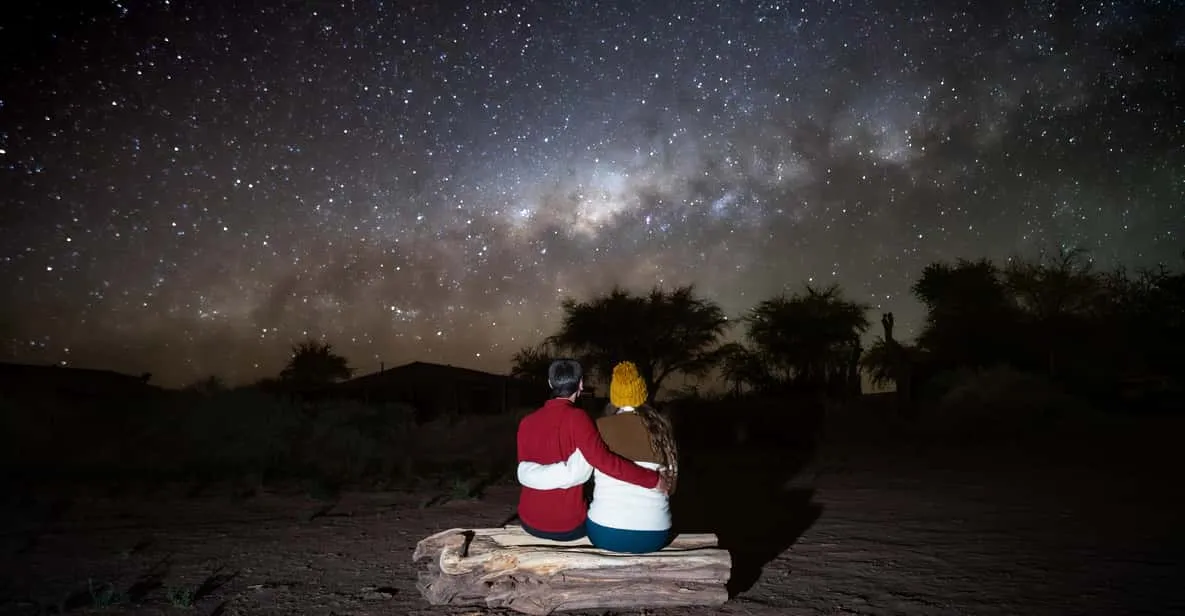
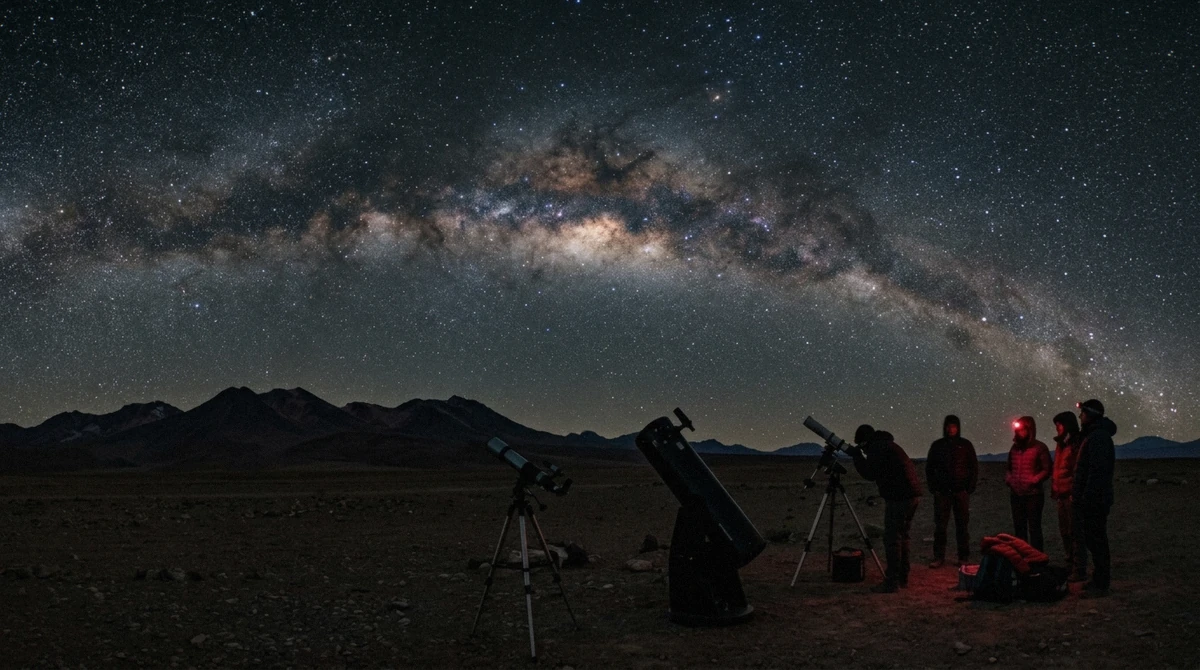
The pro-guided Atacama stargazing astrophotography tour pairs a 12-inch telescope session with a working photographer who shoots three individual portraits of each guest under the Milky Way, a combination most other Atacama Desert stargazing tours skip entirely. Andestellar runs the 3-hour evening session from San Pedro de Atacama with a group capped at 16 travelers, split into sections of 8 so half the group observes through the telescope while the other half works with the photographer, then swaps. Lounge chairs, blankets and a cocktail hour with hot and cold drinks are included, so nobody stands shivering in a field for three hours. At $45 per person with a perfect 5.0 rating across its first 6 reviews, it sits between the budget group tours and the $180-plus private options. This guide covers what the telescope shows you, how the evening unfolds minute by minute, and what to pack so the cold does not ruin it.
Tour At a Glance
Free cancellation up to 24 hours before departure, full refund
Reserve your spot now and pay nothing today
3 hours, evening departure that shifts earlier or later with sunset by season
Hotel pickup and return in San Pedro de Atacama included
Maximum 16 travelers, split into two rotating sections of 8
3 individual astrophotography portraits, delivered digitally in 3 to 5 days
Check Live Availability & Prices
Why This Atacama Stargazing Astrophotography Tour Stands Out
The 12-inch telescope and the dedicated astrophotographer are what separate this tour from the $30 group sessions that pass a small telescope between 40 people. A 12-inch aperture resolves detail that smaller instruments cannot: Saturn's rings as distinct bands rather than a smudge, Jupiter's four Galilean moons as sharp points of light, and the gas clouds inside the Orion Nebula. The guide locates each object and explains what you are looking at, so there is no guessing whether the blur in the eyepiece is a planet or a smear on the lens.
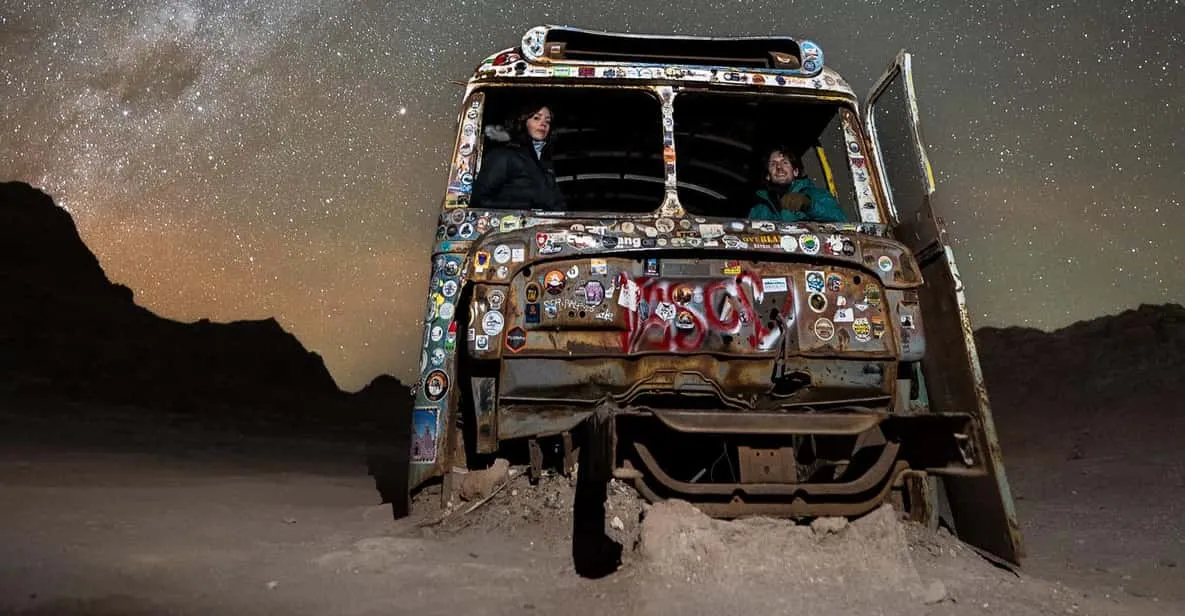
The astrophotography half is the part most competitors leave out. A second guide works exclusively as a photographer, shooting three long-exposure portraits per person with the starry sky as the backdrop, the kind of image a phone camera cannot produce handheld. Reviewers consistently name Frank and Diego, the astronomy guide and photographer pairing, as the reason the tour earns a perfect rating so far. Bryony, who took the tour in May 2026, wrote that Frank made the cosmos easy to follow and that Diego coordinated the photos without slowing the group down. For a side-by-side against the other Atacama Desert stargazing options, including the $33 group session and the $81 private astro tour, see our full stargazing comparison.
What You Will See Through the Telescope and Overhead
The Atacama sky shows roughly 3,000 stars to the naked eye on a clear moonless night, against 200 to 300 visible from a typical city. That gap comes from three factors stacking together: the desert's near-zero humidity, the 2,407-meter base altitude of San Pedro de Atacama, and almost no artificial light for hundreds of kilometers. It is the same combination that led international astronomers to build ALMA's 66 antennas on the Chajnantor plateau at 5,058 meters, which logs more than 300 clear nights a year.
- The Milky Way core, stretching bright enough on a new-moon night to cast faint shadows on the ground
- Saturn and its rings, resolved into distinct bands through the 12-inch telescope
- Jupiter and its four Galilean moons, visible as separate points of light around the planet
- The Orion Nebula, a gas cloud several light-years across where new stars are actively forming
- Omega Centauri, the largest globular star cluster visible from the southern hemisphere
- The Large and Small Magellanic Clouds, satellite galaxies of the Milky Way seen only from southern latitudes
- Constellations explained through both modern astronomy and Lickanantay ancestral sky-reading, which used the same stars for planting and herding calendars
What Is Included and What Is Not Included
| Included | Not included |
|---|---|
| Hotel pickup and return in San Pedro de Atacama | Gratuity for guides |
| Bilingual guide (English, Spanish, Portuguese) covering astronomy and Lickanantay sky-lore | Warm clothing, bring your own layers |
| Guided observation through a 12-inch telescope | Dinner before the tour |
| 3 individual astrophotography portraits under the night sky | Personal camera equipment or lenses |
| Lounge chairs and blankets at the observation site | Souvenirs or personal purchases |
| Cocktail hour with hot and cold drinks | Travel insurance |
How the 3-Hour Evening Unfolds
-
6:30 PM
Hotel pickup in San Pedro de Atacama
Departure time shifts with sunset by season, earlier in June and July, later in December and January. A driver collects you from your accommodation in the village.
-
6:50 PM
Drive to the dark-sky observation site
A short drive clear of the village's streetlights, chosen for minimal light pollution and an open, flat horizon.
-
7:00 PM
Settle in, lounge chairs and blankets
The guide gives a brief welcome and explains how the two rotations will work before the sky talk starts.
-
7:10 PM
Guided sky talk
The guide narrates the visible sky, pointing out constellations and planets, then covers how the Lickanantay people read the same stars for planting and travel.
-
7:50 PM
Cocktail hour
Hot chocolate, coffee, tea and cold drinks are served while the group warms up and the sky darkens further.
-
8:10 PM
Telescope and photography rotation
The group splits into two sections of up to 8. One half observes through the 12-inch telescope while the other works with the photographer, then the sections swap.
-
9:00 PM
Return drive to San Pedro de Atacama
The vehicle heads back into the village once both sections have completed their telescope and photography rotation.
-
9:20 PM
Drop-off at your hotel
You are dropped back at your accommodation. Photos are delivered digitally within 3 to 5 days.
Important Things to Know Before You Book
Book close to a new moon if the Milky Way is the priority. A full moon washes out faint stars and cuts what the telescope can resolve, so operators generally recommend booking within 5 to 6 days of a new moon and note that some stargazing tours pause entirely around the full moon. Check the best months to visit the Atacama Desert for the seasonal cloud risk, since the Altiplanic Winter brings occasional cloud cover in January and February even though the rest of the year runs mostly clear.
- Not suitable for: anyone who cannot tolerate 3 hours outdoors at night in near-freezing temperatures, even in summer
- What to bring: thermal base layer, fleece mid-layer, a proper winter jacket, warm hat, gloves and thick socks; bright clothing photographs better against the night sky than dark colors
- Not allowed: phone flashlights or white light at the observation site, since it ruins night-vision adaptation for the whole group; the guide provides red light when needed
Pickup Point: San Pedro de Atacama
Who This Tour Is Best Suited For
- Travelers who want a souvenir beyond memory: the three astrophotography portraits are the main reason to pick this tour over a cheaper telescope-only session
- Anyone who dislikes standing in the cold for hours: the lounge chairs and blankets make the 3 hours comfortable rather than an endurance test
- Couples and small groups on their last night in San Pedro de Atacama, since a late return and no early alarm the next morning fit the schedule best
- First-time stargazers who want context, not just views: the dual astronomy and Lickanantay sky-lore narration adds depth that a self-guided telescope rental cannot
- Travelers with mobility limitations, since the entire session happens seated at a flat site with no walking or altitude gain involved
For every other night-sky option in the region, from the $33 entry-level session to the private astro tour with big telescopes, browse the full lineup of Atacama Desert tours before you pick a date.
Questions About the Pro-Guided Stargazing and Astrophotography Tour
How is this Atacama astrophotography tour different from the $33 stargazing tours?
The $33 tours typically run larger groups without a dedicated photographer, and guests stand for most of the session. This tour caps sections at 8 people, uses a 12-inch telescope, includes a professional photographer who shoots 3 portraits per person, and provides lounge chairs, blankets and a cocktail hour, all for $45.
When do I receive my astrophotography photos from the tour?
Photos are delivered digitally within 3 to 5 days after the tour ends. You receive 3 individual long-exposure portraits per person, taken with the starry Atacama sky as the background, the kind of shot a handheld phone camera cannot replicate no matter how good the phone is. Check your email and spam folder around the fifth day if nothing has arrived yet.
Does the moon phase affect this Atacama stargazing tour?
Yes, significantly. A full moon washes out faint stars and reduces what the 12-inch telescope can resolve, while a new moon produces the darkest sky and the clearest Milky Way view. Book within roughly 5 to 6 days of a new moon for the best results, and check the operator's calendar since sessions near the full moon may pause.
What temperature should I expect on this Atacama stargazing tour?
Nighttime temperatures at the observation site typically sit between 0 and 5 degrees Celsius even in summer, and can drop toward minus 10 degrees Celsius on winter nights between June and August. Dress in thermal layers regardless of the season; the lounge chairs and blankets help but do not replace a proper jacket.
Can I bring my own camera on this astrophotography tour instead?
You can bring a camera, but a phone will not capture usable night-sky images since the exposure times required go well beyond handheld phone photography. The included photographer handles the long-exposure work with proper equipment, so most guests leave the camera in the bag and let the professional shots do the work.
Is this a good last-night activity in San Pedro de Atacama?
It works well as a closing activity since the return drop-off lands around 9:20 PM, late enough to feel like a proper send-off but not so late it disrupts an afternoon flight the next day. Guests catching a very early morning flight from Calama should book it on an earlier night of their trip instead.
What Guests Say About the Pro-Guided Stargazing Tour
We had an amazing experience on the Pro Guided Stargazing and Astrophotography tour. Both of our guides, Frank and Diego, were incredibly professional, knowledgeable, and friendly throughout the entire experience. Frank did a fantastic job explaining the stargazing and how to use the telescope, making everything easy to understand and engaging for everyone. Diego, the photographer, was excellent at guiding us through the astrophotography process and helped us capture beautiful images of the night sky. The stargazing itself was absolutely breathtaking, and the astrophotography portion was a real highlight—such a unique opportunity. It was also a lovely touch to have snacks provided, which made the whole experience even more enjoyable and relaxed. Overall, this tour exceeded my expectations, and I would highly recommend it to anyone interested in exploring the night sky in a memorable way.
A well organised tour with friendly and informative guides. We enjoyed learning more about the cosmos from Frank and Diego was great at coordinating the photos without it being over the top. The hot drinks and snacks were a nice touch. We would recommend this tour. Make sure to wear lots of layers as it gets very cold!
Sehr schöne Tour von einen jungen, ambitionierten Team. Alles hat bestens funktioniert, von der pünktlichen Abholung vom Hotel, der informativen Erklärung des südlichen Sternenhimmels, des wie von Zauberhand plötzlich aufgetauchten Apero-Buffets, der professionellen Fotografien bis hin zum Blick durch das Teleskop in ferne Welten. Sicher kein hochwissenschaftliches Programm, aber auch für mich als Hobby-Astronomen noch einiges Wissenswertes. Alles in allem ein wunderbarer Abend trotz fast Vollmond, den iwir nur jedem empfehlen können. Am meisten hat uns das ambitionierte, passionierte junge Team überzeugt, Kompliment, was sie aufgezogen haben!
Reviews published on GetYourGuide, read on 6 August 2026. We do not collect or moderate them.
Page last reviewed 2026-08-06. Price, rating and review count read from the listing on 2026-08-06. Prices, availability and terms are set by the operator and confirmed at checkout.
We may earn a commission if you book through one of our links, at no extra cost to you. Full affiliate disclosure · How we research tours